Hernando Beach - Inshore Fishing

My inshore fishing adventures in the Hernando Beach Area.

Thursday, September 24, 2009

More Bluefish, trout and cobia.

We had such a good time yesterday that we decided to do it again. I was hoping the whitebait was still bunch up. They where not and I had to through the net about 10 times to get about 50 baits. The whitebait was still in the same area around the turn marker in the Bayport channel, but they where scattered around due to the birds. Also to note the whitebait was thick in Centipede bay. While catching whitebait a small cobia was chasing the bait around the boat. This kept the bait at a distance from the boat. So the only solution I could find was to toss out a bait with a hook.

While the cobia was short, it did put up a nice fight and once released it left the area.

Once we had the whitebait we ran over to the the Hernando Beach channel and started at marker 5. We used 20# fluorocarbon leader, which proves to be inadequate for the teeth of a blue fish. We lost 4 hook within the first 5 minutes. So I switched out the leaders to 30# which cut done on the hook loses. We caught about 10 bluefish and decided to move and look for some trout. If you want bluefish the cut between markers 5 and 7, I caught them there for the last week. The next couple of cuts we caught 4 trout, but none as big as yesterdays, but all in the 20 inch range. We also picked up an assortment of jacks, lady-fish, blue-runners and a bonnet-head shark and a few small grouper. It rained on and off most of the day, so we did not get many pictures


Next stop was Centipede bay. We started in the back and saw a few fish cruising the rocky area. Tossed out some whitebait and the redfish swam right by it. This was a bit odd, but I think I figured out why a redfish would pass up a whitebait. A few minutes later we heard a crash in the water about 100 yards behind the boat. As it turns out is was a pelican diving on a big school of whitebait. So my guess is the redfish that I saw where coming back from dinner, I though I heard one of them say "I can't eat another bite". We did manage to get a a little 18 inch redfish to bite and he looked like he just got back from an all you can eat buffet.

Next week we plan to head out to some shallow rocks for inshore grouper fishing.

Good Luck
Zippyjr

Tide : .02 11:32am Rising
Water Clarity : clear
Moon Phase: 13% full
Temp: 92F
Water Temp : 84F
Wind: 5 mph NE - 10 mph W
Bait: Whitebait
Results: Trout, bluefish, jacks, cobia, bonnet head shark, ladyfish, rat red, grouper.

Labels: , , , , , , , , ,

Monday, September 21, 2009

Fall Fishing is heating up

After Sunday's one redfish day, I thought we would go for round two. We left out of Jenkins creek to pick up whitebait. We hit the turn marker and the bait was thick. One cast and I could feel the extra weight of the bait fish in a 10 ft net. Which means I now have more bait than the live will hold. Skimmed off the larger baits and tossed in about 100 small baits (for live chum) and headed over to the Hernando Beach Channel.


We started at marker 5 and caught about 10 bluefish and jacks. While this was fun, we where looking for dinner. So we started moving in one cut at a time. The second turned out good. We had a double hook up on trout 25 and 26 inch trout, which filled the limit on 20+ inch trout.


We also caught a 12 inch mangrove snapper. I have seen bigger snapper around the rocks and I am thinking that it might be worth a shot to try to chum up the snapper.
We had a small bluefish on and this little cobia was chasing the bluefish trying to eat it. Clearly the cobia's eyes where bigger than it's mouth. So I tossed out a bait that would fit and he took it.

For those who have never caught a cobia, this is a baby, 40lb cobia are not uncommon. If you do catch one, they pack a big surprise, not only do they fight hard, once boated be very careful of there spines just behind their head. A typical place you would hold the fish when removing the hook.Much to our surprise we caught a 21 inch grouper. I've caught 10-16 inch grouper around the rock, but never one this big. A little bigger and he would have come home for dinner....

Over all it was a good day, we had non-stop catching and pretty good weather.

Good Luck,
Zippyjr

Tide : Rising
Water Clarity : Clear
Moon Phase: 13 % full
Temp: 92 F
Water Temp :84 F
Wind: 5 mph NE - 15mph W
Bait: Whitebait
Results: 4 Trout, 1 Cobia, 3 Grouper, 2 Sea Bass, 1 Mangrove Snapper, 10 Jacks, 5 blue runners, 12 bluefish.

Labels: , , , , , , , , , ,

Tuesday, June 2, 2009

Snook Attack

Today a friend was visiting and wanted to go catch a few redfish. We headed out of Jenkins creek so we could pick up some whitebait on the way. We checked the area around the first turn maker and did not see any so we headed to tri-pod, nothing but big ballyhoo and pin fish. Checked smith rock, nothing. Went back to the turn marker and finally found 3 pods of bait. Over the last few weeks the turn marker is the only place I have found bait.

Once we loaded up with bait, we headed back to Centipede Bay. We spend too much time hunting bait and now the tide had turned. We only had about an hour to fish in the bay and hooked up with two redfish and lost them both! (That's called and auto release...)

The next up was the Hernando Beach Channel in the "cuts". The cuts are the deep reliefs between the rock piles that protect the channel from filling in with sand. I see many anglers there most seem to understand how to fish this area,. Today there was a couple of guys fishing and they anchored up in the middle of the cuts. This is where we catch fish, as you can image they left with out catching anything.
There is about 20 "cuts" along the north side of the channel


The place to anchor is about here and fish between the rocks


We moved from cut to cut tossing out live chum at each stop. One cut down from where the other guys where fishing, there was a big response from the chum. We could not tell what they where, but I suspected that they must have green backs that blended in well with the sea grass on the bottom. The one fish that size with a greenish back is a snook. We pitched a couple of baits with hooks and both of us hooked in to big snook.

The first pair broke off since I had trouble releasing the anchor and fighting the fish to give chase. The next one, I was ready and released the anchor and off we went. I use a trolling motor to chase the fish so it will not spook the other fish. We came back to the anchor thinking that we must have spooked the fish. Only to find another big response to the live chum. This went on for about an hour, then everything stopped. We ended up releasing 5 snook all the 10-12# range. The one draw back to this kind of actions is no one wants to stop and get the camera out to take pictures... Maybe one day I'll get a helmet cam...

The next cut we caught a couple of trout for dinner and decided it was time to call it a good day.

Good Luck
Zippyjr

----------------------------------------------------
Tide : Falling : H 3.0 10:01 am : L 0.40 6:21pm
Water Clarity : Clear
Moon Phase: 78% full waxing gibbous
Temp: 78F
Water Temp : 85F
Wind: 5mph SE morning- 10mph W afternoon.
Bait: Whitebait (green backs, greenies)
Results: 5 Snook release - 2 Red Fish (auto release) - 2 trout

Labels: , , , , , , ,

Saturday, April 25, 2009

Catching Whitebait

Since I mentioned catching whitebait (greenbacks) I thought I would give a little information about using it as live bait. The best live bait is of course pilchard (aka, whitebait, greenies, greenbacks, fish crack etc) every predatory fish ( Redfish, Snook, Grouper, Snapper, Dolphin, Tuna, Sailfish, Cobia, etc) will eat them. Pin fish work well, but are mainly used offshore for grouper. And the ol standby is mud minnows. And of course there is shrimp, one of the easiest, widely available bait around.

Bar none whitebait is my favorite.
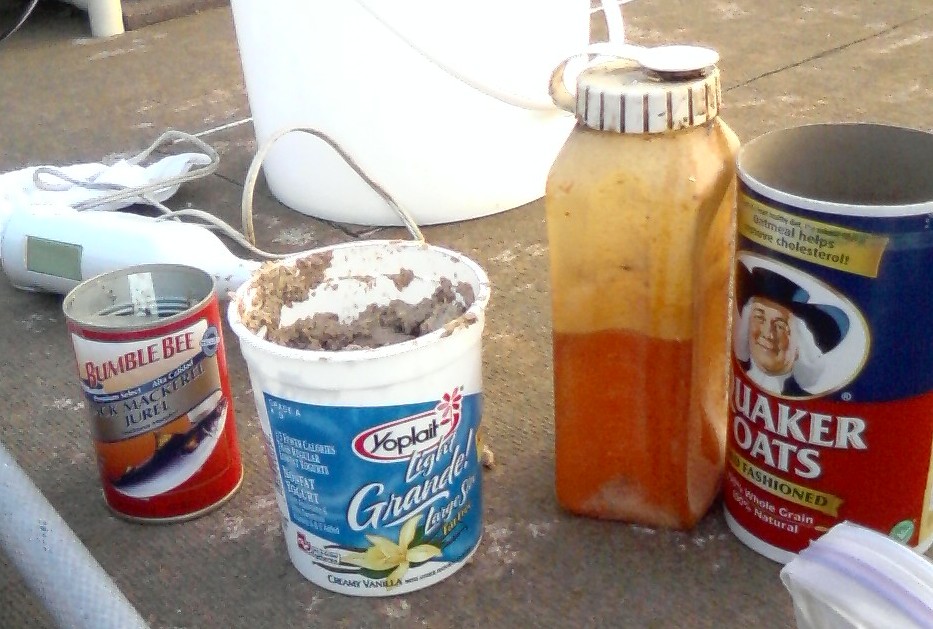
But they come with a high cost, in efforts, equipment and time. In the spring catching whitebait can be difficult. It is not difficult to spend the day looking for bait, traveling 20 miles searching without success. And few days I have spent so much time looking, I ran out of time and went home. Once you find them, most of the time you have to chum them close enough to net then. Of course you have make the chum first (jack mackerel, oats, menhaden oil and garlic oil). I use a food processor to puree the chum in to a fine, gooey, sticky, stinky, fish paste. One important note, DO NOT USE YOUR WIFE'S FOOD PROCESSOR, your food will never taste the same.

The mixing lab... One quart of chum should last several trips.


Then there is the cost in equipment. First off you need a good cast net at least an 8 ft net (when opened it spans 16 ft). The average cost for a net is around $100 for an 8 ft and $120 to $200 for larger nets. I have several nets, two 8ft, one 10 ft and the monster 12 ft. The 10 ft is my favorite, a hand tied 1/4, 1.5 lbs per foot net. A 1/4 net is good for smaller baits since the small baits will not gill, but it also sinks slower. My 12 ft net is 3/8 in net, it sinks fast, covers a lot of area and weighs a ton. I can only throw it a few times then I done. Since it is so big, I make sure the first throw counts. (I use this method to throw the cast net.) Then there is the time spent cleaning the nets. At the end of the day they must be washed and dried then properly stored. Then a couple of times a season they must be soaked in water and fabric softener over night then rinsed and dried. This will keep the net soft, if the net become stuff, it does not open as well and tends to do damage to the bait.

Once the bait is caught, they need to be very happy and have deluxe accommodation in the form of a very good live well.

The live well in a nut shell; the water is pumped in to the bottom of the live well, from ocean, then it drains out of the top, back in to the ocean. The live well needs to have water flowing in all the time. Depending on the size of the live well, will depend on the size of the pump(s) and high speed pickup(s) needed.

Since I have built all my live wells, if anyone is interested I did post a DIY live well project. In my small live I have one high speed pickup and one 750gph pump with a float switch. When the boat is on a plane the high speed pick moves about 800 gph and when the boat is not on a plane the pump moves about 500 gph. This creates a lot of current in the live well and the bait is only happy when swimming. Also whitebait have a very high metabolism, which requires lots a O2 and they produce lots wastes proteins. This is why a flow through live well is a must. If the proteins are not removed from the live well, all the bait all die at the same time. The protein comes in the form of white to off white bubbles, when the bubbles start to stack up it's on only a matter of minutes before all the bait is dead and all the hard work and time involved is wasted.

Now why would anyone work so hard to catch live whitebait. Simple because they are worth it. When I have 100+ baits, I can move from area to area tossing out a handful of bait at each stop. If I see the fish busting the top of the water (only takes 1 or 2 minutes), then I know my efforts are about to pay off.

Whitebait is not for everyone. If you are not willing to go the extra mile or 20... do not waste your time trying to catch whitebait. You can pick up some shrimp or throw gulp jigs. But if fishing is your passion and you have not fished with whitebait, then you are missing out on the most intense fishing you'll ever experience.

Good Luck
Zippyjr

Labels: , , , , , , ,